If you heat with wood—or you’re thinking about doing it for the first time—one question comes up pretty quickly:
How much firewood do I need for winter?
The frustrating answer is “it depends.” The useful answer is that most homeowners can get surprisingly close with a few basic details about their home, climate, heating system and how often they plan to burn.
Quick answer: For a typical Canadian household, plan on roughly 3–5 full cords if wood is your primary heat source, around 1–3 cords for regular supplemental heating, and less than one cord for occasional fires. Your actual use can vary considerably depending on climate, home efficiency, stove efficiency, wood species and moisture content.
Natural Resources Canada’s A Guide to Residential Wood Heating has used a range of roughly three to five full cords for a medium-sized modern home heated exclusively with wood. That’s a useful benchmark—but it shouldn’t automatically become your shopping list.
So rather than ordering four cords because somebody on Facebook said four cords is “about right,” let’s figure out what about right actually means for your house.
Quick Answer: How Many Cords of Firewood Do I Need for Winter?
Here’s a practical starting point for estimating your winter firewood supply:
| How You Use Firewood | Rough Winter Starting Estimate |
|---|---|
| Occasional fireplace or weekend fires | ¼–¾ full cord |
| Wood stove used evenings and weekends | ¾–1½ full cords |
| Regular supplemental heat | 1½–3 full cords |
| Wood provides most of the home’s heat | 2–4 full cords |
| Primary heat for an average-sized home | 3–5 full cords |
| Large, drafty home or very cold climate | 5+ full cords |
These are planning ranges, not guarantees. Two houses sitting beside each other can burn very different amounts of wood.
The trick is figuring out which end of the range you belong at.
Before You Estimate: Know What a Cord Actually Is
This matters more than you might think.
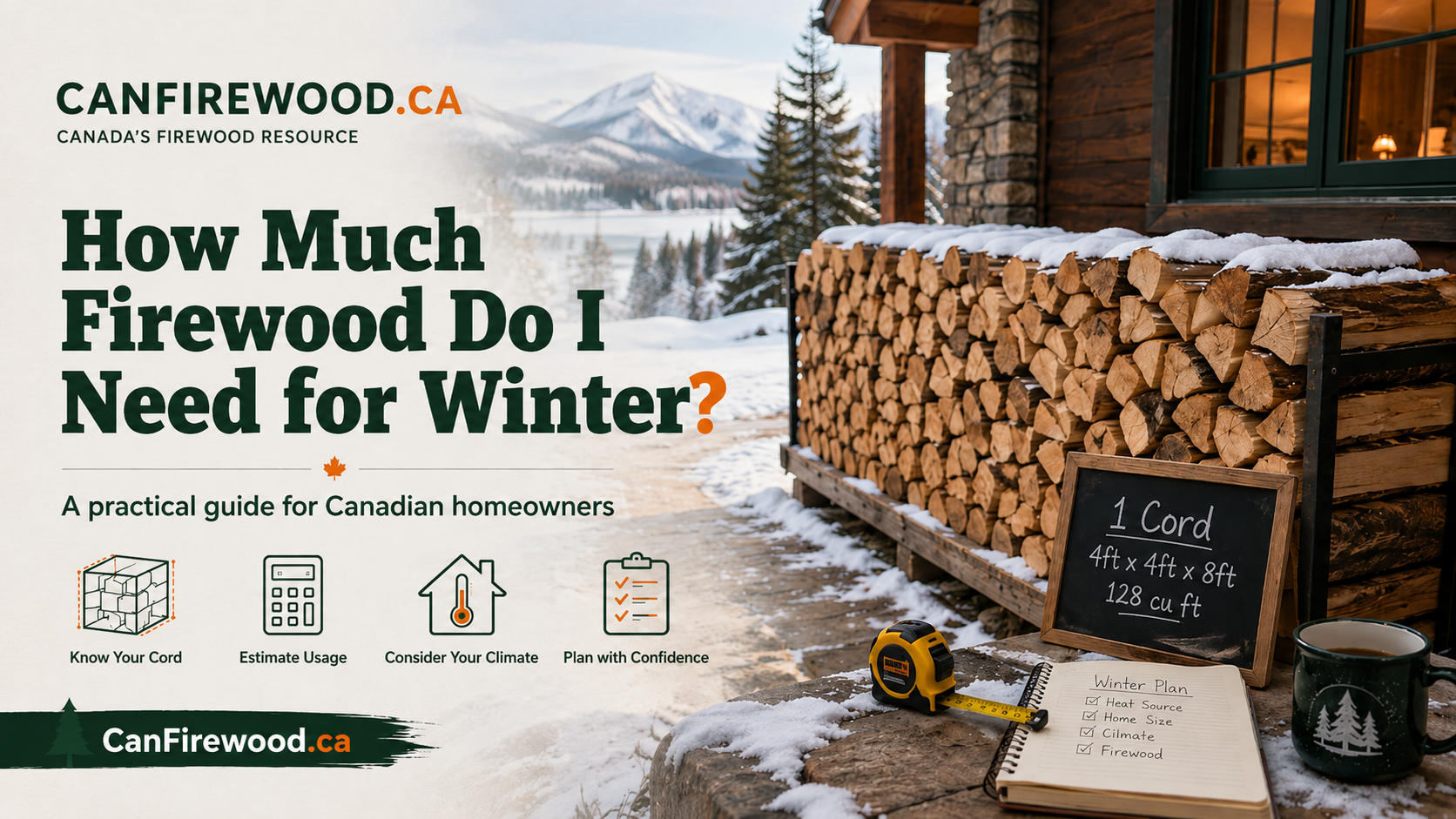
In Canada, one full cord of firewood equals 128 cubic feet of closely stacked wood, including the normal air spaces between the pieces.
The familiar example is a stack measuring:
4 feet high × 4 feet deep × 8 feet long = 128 stacked cubic feet.
If you’d like the full explanation, including stacked cubic metres and how to measure a delivery yourself, see our Firewood Measurements guide.
Face Cord vs Full Cord
This is where estimating winter firewood can get confusing.
A full cord has a defined volume.
A face cord does not tell you the complete volume unless you also know how long the pieces are.
A traditional 4-foot-high by 8-foot-long face cord made with 16-inch pieces works out to approximately one-third of a full cord. Change the pieces to 12 inches or 18 inches and the amount of wood changes.
So if someone tells you they burn “six cords every winter,” your next question should probably be:
Full cords or face cords?
That one detail can turn six “cords” into something much closer to two full cords.
We’ve broken this down with examples and measurements in our Face Cord vs Full Cord guide.
6 Things That Determine How Much Firewood You Need
There isn’t a magic number based entirely on square footage. In many cases, the following factors matter just as much.
1. Is Wood Your Primary Heat Source?
This is probably the biggest factor.
Someone lighting a fire after supper three nights a week might not burn a full cord all winter. Someone keeping a wood stove going around the clock through January and February could burn several.
Think of your wood use in four general categories:
- Occasional use: fireplaces, weekend fires and the odd cold evening.
- Supplemental heat: taking some of the load off a furnace, boiler, electric baseboard or heat pump.
- Major heat source: the stove runs most days and provides a significant percentage of household heat.
- Primary heat: wood does almost all the heavy lifting.
Be realistic here. Calling your wood stove “supplemental” while feeding it every eight hours from November through March is technically possible, but your woodpile may disagree.
2. Where Do You Live?
Winter in Windsor is not winter in Timmins.
A home in southern Ontario, coastal British Columbia or a milder part of the Maritimes can have a very different heating load than the same home in northern Ontario, northern Quebec, the Prairies or Yukon.
Longer heating seasons mean more burn days. Colder temperatures mean larger or more frequent fires.
Wind exposure matters too. A house sitting in an open field can lose heat faster than an identical house protected by trees and neighbouring buildings.
If you’re in a colder part of Canada, move your estimate toward the higher end of the range.
3. How Big—and How Efficient—is Your Home?
Square footage matters, but insulation matters almost as much.
A newer 1,800-square-foot home with good insulation, modern windows and controlled air leakage may require less firewood than a drafty 1,200-square-foot farmhouse.
Things that can increase firewood use include:
- Older windows and doors
- Poor attic insulation
- Unfinished or poorly insulated basements
- Air leaks
- High ceilings
- Large open areas
- Poorly insulated additions
- Frequently opening exterior doors
If your curtains move when the wind blows outside, add some extra wood to the pile.
4. What Kind of Wood Stove Are You Using?
Not all wood-burning appliances turn a log into useful heat equally well.
Modern high-efficiency wood stoves and fireplaces can extract considerably more useful heat from the same amount of fuel than many older appliances.
Placement matters too.
A stove located centrally in the home’s main living area can usually distribute heat more effectively than one tucked into a distant basement room while you try to convince warm air that it really should travel upstairs.
If you’re replacing an old stove with a newer high-efficiency model, don’t automatically assume last year’s firewood consumption will be this year’s consumption.
5. What Species of Firewood Are You Burning?
A cord measures volume, not energy.
Dense hardwoods such as maple, oak and beech generally contain more wood mass in the same stacked volume than lighter species.
That means a full cord of dense hardwood can generally provide more heating time than the same stacked volume of a lower-density species.
That doesn’t make softwood bad firewood. Properly dry softwood can make excellent heating fuel. You may simply burn through the pile faster.
If you’re comparing suppliers, don’t compare price per cord without also asking what species or mix is included. You can compare common Canadian firewood types in our Firewood Species guide.
6. How Dry Is Your Firewood?
You can have six cords stacked behind the house and still be short on usable firewood if half of it isn’t ready to burn.
Wet wood wastes heat because part of the fire’s energy has to evaporate water inside the log before that energy can help heat your home.
For ready-to-burn firewood, a moisture reading of around 20% or lower on a freshly split interior face is a useful benchmark.
That means moisture content doesn’t just affect how well your firewood burns. It can affect how much firewood you need.
Dry firewood gives you more useful heat from the wood you’ve already paid for. Our Firewood Moisture Content & How to Test It guide explains how to check your wood properly with a moisture meter.
A Better Way to Estimate Your Winter Firewood
If this is your first winter heating with wood, start with the estimates above and work through these five steps.
Step 1: Decide How Much Heating Wood Will Provide
If it’s mainly occasional use, stay toward the lower ranges.
If your furnace thermostat is basically becoming a decorative wall accessory, move higher.
Step 2: Adjust for Your House
Well-insulated and compact? Move your estimate down.
Large, old or drafty? Move it up.
Step 3: Adjust for Your Climate
Milder Canadian winter? You may need less.
Long, consistently cold winter? Plan for more.
Step 4: Adjust for Your Stove and Firewood
A modern efficient stove burning properly seasoned dense hardwood can make very good use of each cord.
An older appliance, wetter wood or predominantly lighter species can push your required volume upward.
Step 5: Add a Reserve
For your first winter, having roughly 15–20% more firewood than your best estimate gives you some breathing room if the winter is colder than expected.
It’s much more comfortable than discovering on February 8 that your woodshed is looking suspiciously empty.
The Most Accurate Firewood Calculator Is Your Own Woodshed
Once you’ve heated the same home for a full winter, your own consumption history becomes more useful than almost any generic online chart.
Keep track of:
- How much firewood you started with
- When regular burning began
- Approximately how much remained in spring
- What species you burned
- Whether the winter was unusually mild or cold
- Whether wood was your primary or supplemental heat
- Any major changes to insulation or heating equipment
After a season or two, you’ll know your home’s normal consumption surprisingly well.
You Can Also Track Your Burn Rate Mid-Winter
You don’t even need to wait until spring.
Measure a known section of your woodpile and see how long it lasts.
For example, suppose you burn half a full cord over 30 typical winter days.
Half a cord is 64 stacked cubic feet.
At that rate, 150 similar burn days would require roughly 320 cubic feet of wood, or about 2½ full cords.
Then add some reserve for unusually cold weather.
It isn’t perfect—January usually burns more wood than October—but it’s far more useful than guessing.
Should I Buy Extra Firewood?
If you have the storage space and the wood is properly seasoned, buying slightly more than you expect to burn is usually sensible.
Properly stored firewood doesn’t suddenly become useless when spring arrives. If anything, having next winter’s wood already drying and stacked puts you ahead of the game.
Running out of firewood during a February cold snap is a much less attractive option.
A reasonable approach is to think in three numbers:
- Expected amount: what you realistically think you’ll burn.
- Comfortable amount: your estimate plus roughly 15–20%.
- Reserve: additional seasoned wood you can carry into the following winter.
If you estimate three cords and have room to properly store three and a half, you’re probably not going to regret the extra half cord.
Don’t Wait Until the First Cold Snap to Order
There’s another reason to estimate your winter firewood needs early: availability.
Good dry firewood can become harder to find once winter is underway, especially during prolonged periods of cold weather.
Buying earlier gives you more time to:
- Compare local suppliers
- Ask about firewood species
- Confirm exactly how much wood you’re buying
- Check moisture content
- Stack the delivery properly
- Allow borderline wood additional drying time
It also saves you from becoming the person frantically searching for “firewood near me” while the temperature is dropping and every supplier’s phone is already ringing.
How Much Space Will My Winter Firewood Take?
Don’t forget that several cords of firewood require several cords’ worth of storage.
One full cord occupies 128 cubic feet when closely stacked.
- 1 full cord: 128 stacked cubic feet
- 3 full cords: 384 stacked cubic feet
- 5 full cords: 640 stacked cubic feet
You don’t need one giant 4-foot-deep wall of firewood. Multiple narrower rows are often easier to stack and can provide better airflow.
Keep your firewood off wet ground, protect the top from rain and snow, and allow air to move around the sides. Our Storage & Burning guide goes into proper firewood storage in more detail.
So, How Much Firewood Do I Need for Winter?
For many Canadian homeowners, these are reasonable starting points:
- Less than 1 full cord if you burn occasionally.
- 1–2 full cords if wood is mainly supplemental heat.
- 2–4 full cords if your stove provides a large portion of household heating.
- 3–5 full cords if you’re heating an average-sized home primarily with wood.
- 5 cords or more may be realistic for a large, older or poorly insulated home, a very cold climate, or a household burning lower-density wood.
But the best number isn’t the national average.
It’s the amount your home, your stove, your climate and your family actually burn.
Start with a sensible estimate, buy properly measured dry firewood, keep track of your usage and add a little reserve.
After one Canadian winter, you’ll know far more about your firewood needs than any calculator ever will.
And if there’s half a cord left in April?
Congratulations. You’re already ahead for next winter.
Find Firewood Near You
Once you know approximately how much firewood you need, the next step is finding the right supplier.
CanFirewood helps Canadians search local firewood suppliers and compare practical details including firewood species, delivery options, selling formats, moisture information and service areas.
Find local firewood suppliers near you →
Buy local. Burn local. And order enough that February doesn’t become interesting for the wrong reason.