Buying firewood should be pretty simple. You need wood, someone has wood, money changes hands, everyone goes home happy.
And then somebody says, “It’s $180 a face cord.”
Now you’re trying to figure out face cord vs full cord, whether either one is the same as a bush cord, how many face cords make a full cord, and why buying a pile of trees suddenly requires a calculator.
Firewood measurements can be surprisingly confusing, especially because different sellers sometimes use the same words to mean slightly different things. So let’s sort it out.
By the end of this article, you’ll know what a full cord is, what a face cord usually means, how to measure your own firewood, and how to compare prices without needing a degree in advanced firewood mathematics.
Face Cord vs Full Cord: What’s the Difference?
The simplest difference is volume.
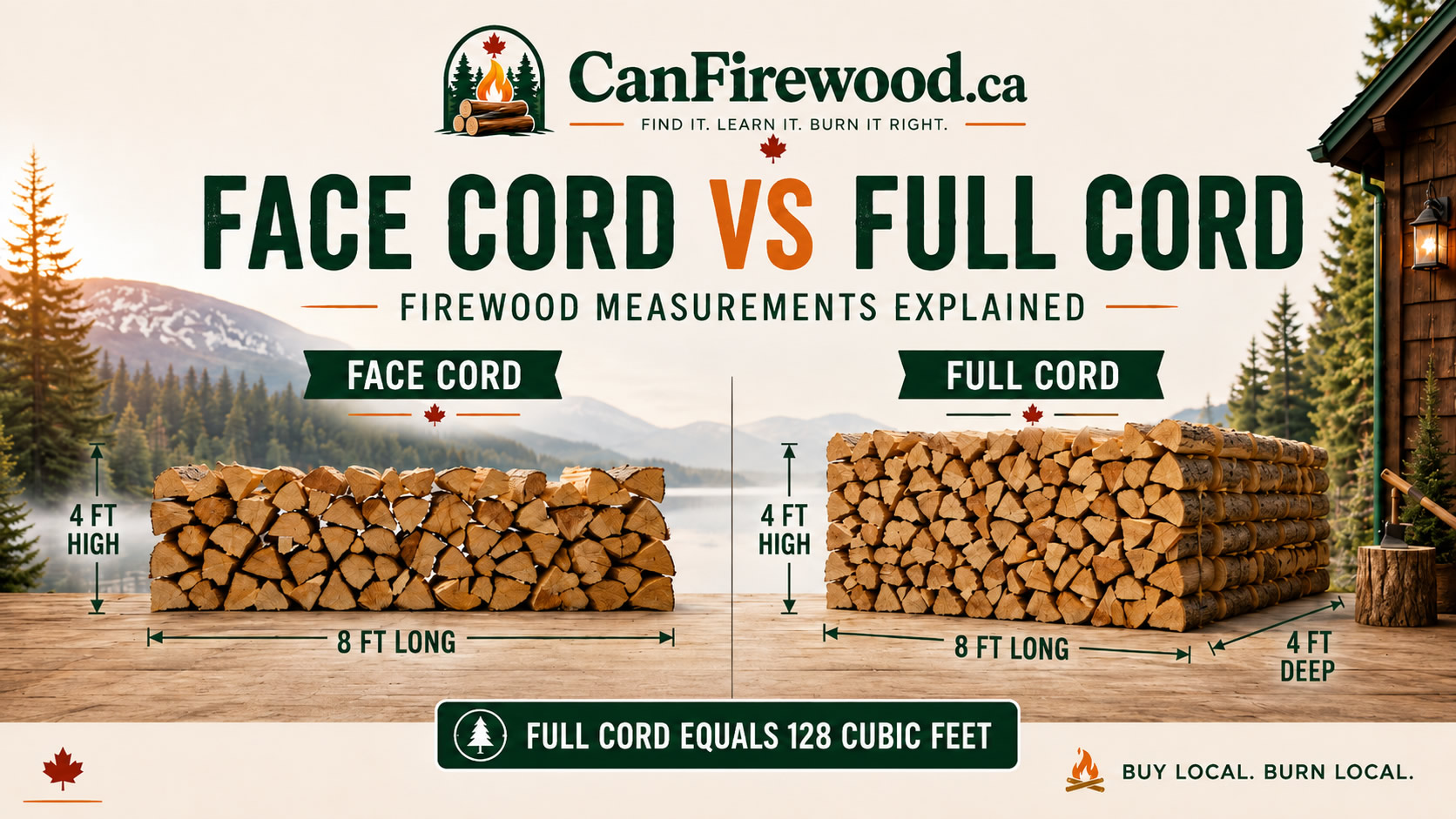
A full cord contains 128 stacked cubic feet of firewood. A face cord usually describes one row of firewood about 4 feet high and 8 feet long, but the amount of wood in that row depends on how long the pieces are.
That missing depth measurement is why the face cord vs full cord comparison can get confusing.
A face cord of 16-inch pieces is roughly one-third of a full cord. A face cord of 12-inch pieces is closer to one-quarter of a cord.
So when comparing the two, remember:
A full cord has a defined volume. A face cord does not unless you also know the piece length.
What Is a Full Cord of Firewood?
Let’s start with the easy one. A full cord of firewood contains 128 stacked cubic feet of wood.
The classic example is a stack measuring 4 feet high × 4 feet deep × 8 feet long. Multiply that together and you get 128 cubic feet.
The stack does not actually have to be arranged exactly 4 × 4 × 8. You could have a longer, shorter, taller, or shallower stack. As long as the total stacked volume adds up to 128 cubic feet, you have one cord.
1 cord = 128 stacked cubic feet.
Pretty straightforward. Enjoy that feeling. It does not last.
So What Is a Face Cord?
A face cord usually refers to one row of firewood approximately 4 feet high × 8 feet long.
Sounds simple enough, except there is one measurement missing: depth.
The depth depends on how long the individual pieces of firewood are. That means two piles can both be advertised as a face cord while containing very different amounts of wood.
Imagine two stacks sitting side by side. Both are four feet high and eight feet long. One contains 16-inch logs. The other contains 12-inch logs. From the front, they look like the same amount of firewood, but they are not.
That is the catch with the term face cord. It tells you what the face of the pile looks like, but not necessarily how much wood is actually in it.
How Many Face Cords Are in a Full Cord?
You will often hear people say three face cords equal one full cord. That can be true, but only under certain conditions.
If the pieces are approximately 16 inches long, then a traditional 4-foot-high by 8-foot-long face cord works out to roughly one-third of a full cord.
Sixteen inches is about 1.33 feet, so:
4 ft × 8 ft × 1.33 ft = about 42.7 cubic feet
A full cord is 128 cubic feet, so 42.7 cubic feet is roughly one-third of a cord. Three of those rows would equal approximately one full cord.
But change the log length and everything changes.
With 12-inch pieces, the pile is only one foot deep:
4 × 8 × 1 = 32 cubic feet, or ¼ cord.
With 24-inch pieces, the pile is two feet deep:
4 × 8 × 2 = 64 cubic feet, or ½ cord.
So simply asking “How much is a face cord?” does not always tell you enough. A better question is:
“How long are the pieces, and how much stacked wood am I actually getting?”
That one question can save a lot of confusion.
Quick Face Cord Comparison
For a stack that is 4 feet high and 8 feet long:
| Piece Length | Approximate Volume | Approximate Portion of a Full Cord |
|---|---|---|
| 12 inches | 32 cubic feet | 1/4 cord |
| 16 inches | 42.7 cubic feet | 1/3 cord |
| 18 inches | 48 cubic feet | 3/8 cord |
| 24 inches | 64 cubic feet | 1/2 cord |
So if two suppliers are both advertising a face cord, but one cuts at 12 inches and the other at 16 inches, they are not selling you the same amount of wood. That matters when you compare prices.
What Is a Bush Cord?
If you live in Ontario, you have probably heard the term bush cord.
In many parts of the province, people use bush cord to mean the same thing as a full cord: 128 stacked cubic feet.
That said, firewood terminology has a habit of changing depending on who you are talking to. Rather than assuming, ask:
“When you say bush cord, do you mean 128 stacked cubic feet?”
If the answer is yes, great. If the answer starts with “Well, sort of…” you probably want a little more detail.
What About Stove Cords, Apartment Cords and Truckloads?
Firewood has collected plenty of other nicknames over the years. You may see wood sold as stove cords, apartment cords, fireplace cords, truckloads, trailer loads, pickup loads, racks, or simply “loads.”
These terms can be convenient, but they do not necessarily tell you an exact amount.
A “truckload” sounds impressive, but what kind of truck? A half-ton pickup? A one-ton dump truck? A dump trailer? A truck that has been carefully loaded? A truck where somebody threw the pieces in from twelve feet away?
There can be a very large difference.
This does not mean sellers using these terms are doing anything wrong. It simply means you should ask how much actual firewood is included.
The Best Way to Compare Firewood Prices
Suppose you see two advertisements:
Supplier A: Face Cord — $175
Supplier B: 1/3 Cord — $200
At first glance, Supplier A seems cheaper. Easy choice, right?
Not necessarily.
If Supplier A’s pieces are 12 inches long, that face cord is approximately 32 cubic feet. Supplier B’s one-third cord is approximately 42.7 cubic feet.
Now suddenly the “more expensive” supplier is giving you more wood.
And we have not even considered wood species, moisture content, delivery, stacking, piece length, kiln drying, seasoning, distance, or minimum order.
Firewood pricing makes a lot more sense once you compare the actual amount of wood first. Then you can compare everything else.
How to Measure Firewood Yourself
If the wood has been stacked, measuring it is surprisingly simple. You just need three measurements:
Length × Height × Depth
That gives you the total stacked cubic feet.
For example, if your stack measures 8 feet long, 4 feet high, and 16 inches deep, first convert 16 inches to approximately 1.33 feet.
Then:
8 × 4 × 1.33 = approximately 42.6 cubic feet
Now divide by 128:
42.6 ÷ 128 = approximately 0.33 cords
So you have roughly one-third of a full cord.
Congratulations. You are now qualified to annoy your friends by measuring their firewood piles.
Why Measuring a Loose Pile Is Harder
Loose firewood takes up more space than stacked firewood because there are larger air spaces between the pieces.
Once those same pieces are stacked neatly, the gaps become smaller and the overall pile takes up less room.
That is why looking at a pile dumped in your driveway and saying, “Yeah, that looks like a cord,” is not exactly scientific.
It might be. It might not be.
The easiest way to know the stacked volume is to stack it and measure it.
Does Piece Length Really Matter That Much?
Yes, and not only because of measurements. Piece length also determines whether the firewood fits in your stove.
Nothing improves a winter evening quite like discovering that every piece in your freshly delivered load is two inches too long for your firebox.
Before ordering, know the recommended log length for your stove, fireplace, furnace, or boiler. Then ask the supplier how long they cut their wood.
A common length might be around 16 inches, but suppliers vary. If you have a smaller stove, this is definitely worth confirming before the truck arrives.
Questions to Ask Before Buying Firewood
You do not need to interrogate the supplier like a detective, but a few simple questions can prevent most misunderstandings:
- How much wood am I actually getting? Ask for the quantity in cords, a fraction of a cord, cubic feet, or another clear measurement.
- How long are the pieces? This helps you understand both the volume and whether the wood will fit your appliance.
- Is the measurement stacked or loose? A loose truckload and a stacked measurement are not the same thing.
- What species is it? Mixed hardwood, maple, birch, ash, softwood, or something else?
- How dry is it? “Seasoned” is helpful, but moisture content tells you much more.
- Is delivery included? A cheap pile of firewood can stop being cheap quickly once a long-distance delivery fee gets added.
- Is stacking included? Usually not, but some suppliers offer it for an additional fee.
Is a Face Cord a Bad Way to Buy Firewood?
Not necessarily.
Face cords are extremely common and plenty of reputable firewood suppliers use the term. The problem is not the term itself. The problem is buying without knowing what the seller means by it.
If a supplier tells you, “It’s a 4-by-8 row of 16-inch hardwood,” great. Now you know exactly what you are getting.
If the description is simply “Big face cord. Lots of wood,” you may want to ask another question or two.
A Simple Rule for Buying Firewood
Here is probably the easiest rule to remember:
Do not compare the name of the load. Compare the amount of wood.
A face cord, bush cord, trailer load, truckload, or stove cord can all be useful shorthand, but the actual quantity is what matters.
Once you know the volume, you can compare suppliers properly.
Find Firewood Near You
One of the reasons we created CanFirewood was to make buying firewood a little less complicated.
Instead of digging through classified ads, marketplace posts, and social media groups, you can search for firewood suppliers serving your area and learn more about what they offer.
When comparing suppliers, look at firewood quantity, species, moisture and wood condition, delivery area, delivery options, piece length, minimum orders, and supplier services. Then contact the supplier directly to confirm availability and current pricing.
CanFirewood does not sell the firewood. We help you find the people who do.
Frequently Asked Questions
How many cubic feet are in a full cord?
A full cord contains 128 stacked cubic feet.
Is a face cord the same as a full cord?
No. A face cord is usually one row of wood about 4 feet high and 8 feet long. The actual volume depends on how long the pieces are.
How many face cords equal one full cord?
If the firewood is cut to approximately 16 inches, about three traditional face cords equal one full cord. If the pieces are shorter or longer, that number changes.
Is a face cord one-third of a cord?
It can be. A 4-foot-high by 8-foot-long row of 16-inch pieces is approximately one-third of a full cord. A face cord of 12-inch pieces would only be about one-quarter of a cord.
Is a bush cord the same as a full cord?
In many parts of Ontario, bush cord is commonly used to mean a full cord. Still, it is worth confirming that the seller means 128 stacked cubic feet.
What is half a cord?
Half a cord is 64 stacked cubic feet.
What is a quarter cord?
A quarter cord is 32 stacked cubic feet.
Can I measure firewood after delivery?
Absolutely. Stack the wood, measure the length, height, and depth, multiply those numbers together, and divide the result by 128. That will tell you approximately how many cords you have.
The Bottom Line
Firewood measurements are only confusing until you know what to ask.
Remember: 1 full cord = 128 stacked cubic feet.
A face cord does not automatically equal one-third of a cord unless the pieces are around 16 inches long.
And if someone offers you a truckload, trailer load, bush cord, or anything else, there is nothing wrong with asking:
“How much stacked firewood is that?”
A good supplier should be able to answer.
Once you know the actual quantity, comparing firewood becomes a whole lot easier.
Looking for Firewood Near You?
Use CanFirewood.ca to find local firewood suppliers serving your community.
Find Local Firewood. Know What You’re Burning.